
US 2008 Prospective Plantings
- Monday April 14 2008
This analysis featured in the April 14, 2008 issue of the HGCA's MI Prospects, Volume 10, Issue 21
The USDA’s Prospective Plantings survey, made in early March, indicated that US farmers plan to plant a total of 104.9Mha to the major crops, up 1.9Mha from 2007. This would be the largest area planted since 2000.
The USDA Planting Intentions Survey results have particular significance this year, as it is the first comprehensive survey relating to spring plantings. Projections based on economic models are likely to prove less reliable than they have in the recent past as they are ultimately dependant on past experience and prices this year have been beyond any experience.
US farmers' planting decisions are quite complex. This is particularly so when most crop prices are favourable, but there are two overriding factors at play this year. The global supply situation this year for wheat is very tight with quite exceptional prices. Fuel ethanol demand for maize has provided seemingly limitless consumption prospects although prices are not as exceptional as those for wheat. As maize competes with soyabeans for plantings, maize prospects have improved dramatically as well.
Opportunities for increases in the planting of hard red winter wheat (HRW), grown predominantly in the drier Great Plains area west of the Mississippi, are quite limited. They are from land released from conservation reserve programmes and from reductions from the very limited areas of cereal grains grown in this region. The same scenario generally exists in the Pacific North West with soft winter wheats. Soft red winter wheat (SRW) are, however, grown in more diversified farming situations, mostly east of the Mississippi. The challenge here is that in this region wheat generally competes with maize and soyabeans, although in some cases there are niche agronomic conditions that favour wheat. Most of the increase in wheat area this year is from SRW wheat. Last fall HRW wheat planting was limited in some areas by moisture conditions.
These limitations together possibly explain why total winter wheat area is up only 4% at 19.0Mha, although this did follow an 11% increase last year (Table 1). The prospective 2008 spring wheat area is up just less than 10% at 6.9Mha and the all wheat area is up just less than 6% at 25.8hMha. While this would be the largest area since 1998, it is not large in comparison with US farm support which influenced planting prior to that.
continue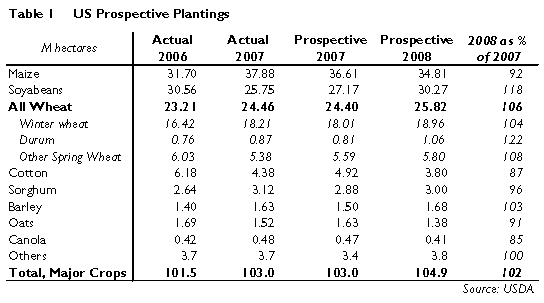
Where the competition between crops is keenest is with maize and soyabeans. Prospective plantings for the pair are a record 65.1Mha, up 2%, but within that increase is a 9% cut in maize area and an 18% rise in soyabean area. At this time last year, record ending stocks of soyabeans were forecast - and became a reality. Maize prospects, as a result of the US’s recently introduced energy security program with its very ambitious fuel ethanol targets, were very positive. Accordingly there was a big switch in plantings from soyabeans to maize. This year’s adjustment reflects much improved soyabean prospects and a return to a more usual split between the two crops(Graph 1). The increase in the total area for the two crops appears to have come from a further reduction in cotton area to 3.8Mha, 23 and 36%, respectively, below 2006 and 2007 areas.
continue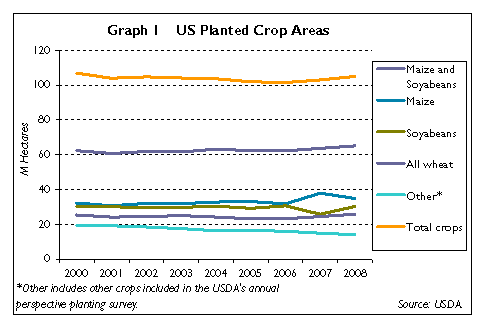
Supply Projections
To provide an indication of supply prospects suggested by these areas, supply projections made at the USDA outlook conference six weeks ago have been adjusted to reflect changed planting projections (Table 2). Production was simply adjusted by the change in area using the USDA yield projections. From the derived supply, projected domestic use was subtracted together with the smallest carry-over in the last five years to obtain export potential.
continue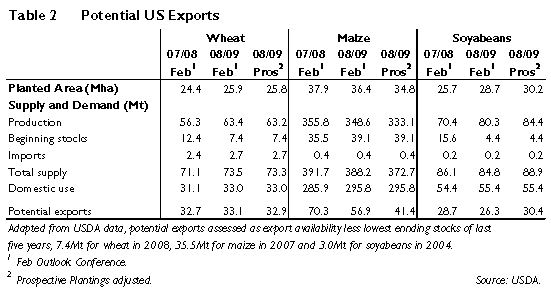
For wheat, the adjustment is very small. The winter wheat area was already known when the Outlook Conference projections were made and the potential for spring wheat area adjustments are more limited than for the other two major spring planted crops. Export potential is on a par with this year’s much increased level. Whether this year’s exports reach this level is almost certainly in doubt with early prospects of much improved global wheat output.
The 15Mt downward adjustment in maize production resulting from the increase in area prospects indicated in the prospective planting survey, reduces potential export to 41.3Mt; the smallest level of exports since 2002/03. This is a very real expectation with US ending-stocks likely to be reduced below the very tight ending-stock level of 35.5Mt in 2007.
The extra 1.5Mha of soyabeans will add, assuming the USDA yield and domestic use projections, about 4Mt to potential exports. At 30.4Mt they are about 1.7Mt above this year’s projected exports. With global oilseed prospects now so dependent on South American production, and Brazilian and Argentine harvest for next year 12 months away, it is clearly too early to assess if the full US export potential may be reached.
Concluding Remarks
Market reaction to the prospective plantings was initially unambiguous. New crop maize price rose by 6% in four days, while new crop soyabeans lost 6% in a single day. Thereafter questions were raised as to whether farmers would not adjust their plans to the price movements. Most US maize/soyabean producers have rather more than a month before final planting decisions need to be made.
It is normal to caution that the prospective plantings survey was undertaken in early March about a month prior to the release date. Hence it reflects conditions, and particularly prices, at that time. But as prices are currently so volatile, it is probably futile to attempt to figure out what farmers’ perceptions might be on the relative profitability of the two crops at any particular point in time.
Also in the past it was reasonable to anticipate that any significant delay in sowing would result in an increase in late sown soyabeans at the expense of earlier sown maize. Last year almost half of a record maize crop appears to have been sown in a single week just when it appeared that farmers might have to change their plans. The implications of this is that delays will need to be major for there to be any significant impact on area.
David Walker 001 780 434 7615
top of page